On 9 October 2026, the German Business Travel Association (Verband Deutsches Reisemanagement, VDR) published its white paper “KI in Business Travel” and presented it in an online session. The scientific study behind it was carried out by the Institute of Tourism, Travel & Hospitality (ITTH) at Heilbronn University, led by Prof. Dr. Stephan Bingemer. I received the white paper in advance and attended the presentation live. My conclusion up front: the study does not tell us what will happen. That is exactly what makes it useful.
Not a forecast, but a playing field
Bingemer stressed right at the start that this is an exploratory study. It does not try to predict anything. It sets out a playing field on which different futures have different likelihoods. There are far more than the four scenarios in the study. According to Bingemer, there are four purely for didactic reasons: a 2×2 matrix is something practitioners can work with.
The “scenario funnel” was a helpful illustration. It distinguishes between plausible, probable and preferred futures. The probable and preferred futures are usually extensions of what we already know, which is exactly where forecasts tend to fail. His example: the business travel growth forecasts made before 2020 were worthless once the pandemic arrived. The value of scenarios therefore lies less in the future itself than in the question of what we can do today. The method comes from the European Tourism Futures Institute and was applied here for the first time with a large sample in the German business travel market.
How the study was built
- Horizon scan: 20 companies contributed a total of 652 statements, an average of 43 per company. The topics went far beyond technology: hybrid work, sustainability, work-life balance, demographics, the economy.
- Scenario workshop: 15 of these companies spent a full day on it. Only travel managers took part, deliberately without suppliers, so that the study would not be shaped by the solutions available today.
- Supplier perspective: Afterwards, 15 suppliers ran their own horizon scan. They did not know the scenarios, and the core directions were confirmed. Bingemer acknowledged that this part is smaller, less robust and more focused on technology.
- Scenario axes: Out of four drivers, two axes remained: how connected AI is (from fragmented to end-to-end) and how autonomous AI is (from human-in-the-loop to autonomously deciding). “AI as an efficiency driver” was excluded because it depends on autonomy and is not an independent axis.
The four futures
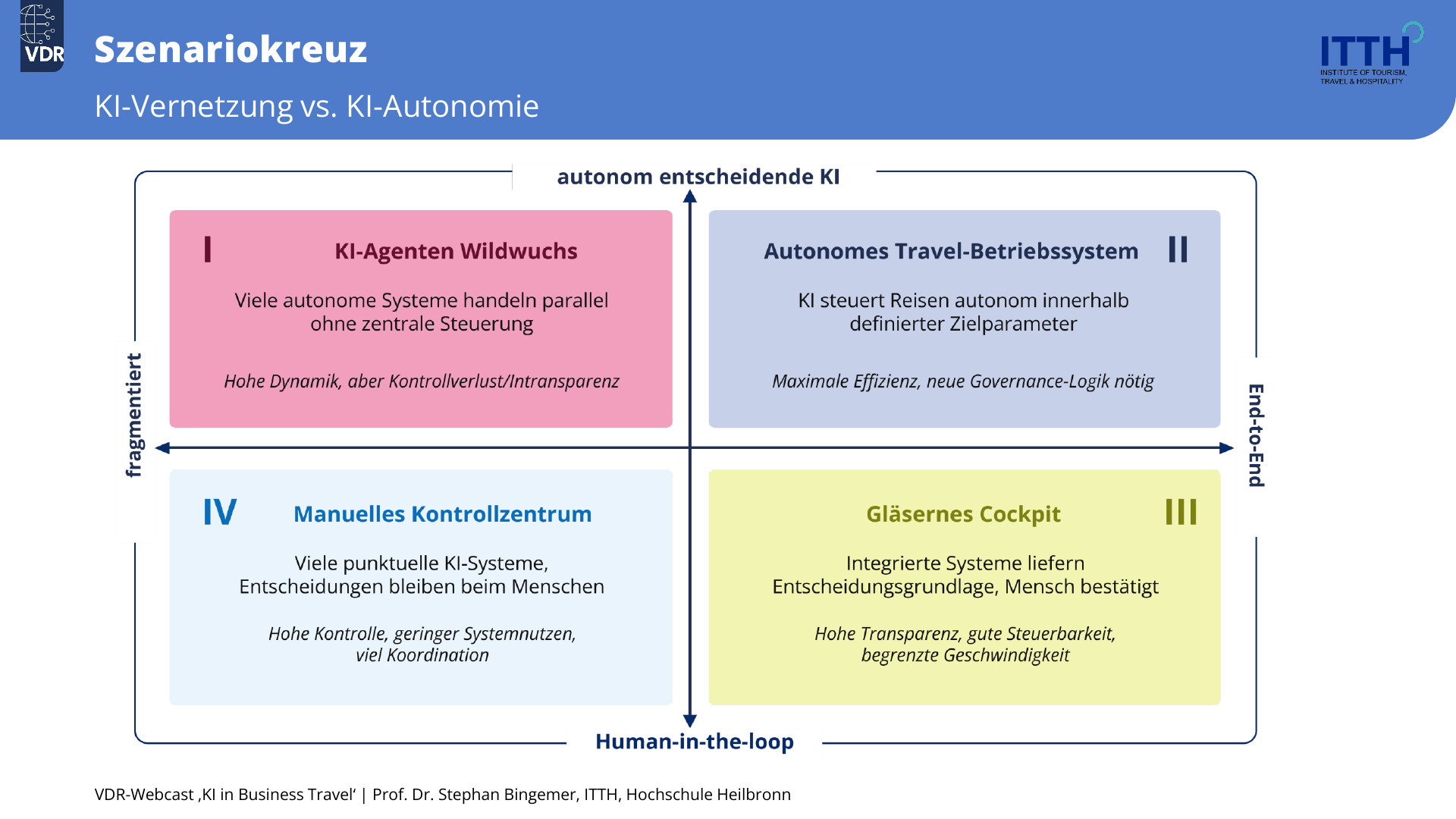
1. AI agent sprawl (KI-Agenten-Wildwuchs). According to Bingemer, this is not a future scenario. It is already visible in many companies today: employees use private AI tools on their own devices and enter company content. This brings speed and convenience for travellers, but opacity and loss of control for the organisation, plus data protection risks.
2. Autonomous travel operating system (Autonomes Travel-Betriebssystem). A fully connected system manages travel within defined target parameters. Efficiency would be at its maximum. The travel manager shifts from hands-on operator to setter of guardrails and controller. Bingemer compared the role to a referee who rules on video review.
3. Glass cockpit (Gläsernes Cockpit). The AI provides the basis for decisions, and a human confirms. This is transparent and easy to steer, but slower. Bingemer also named the risk: people might simply click through recommendations and unlearn how to question AI results critically.
4. Manual control centre (Manuelles Kontrollzentrum). Many point solutions, for example for receipt capture or forecasting, with little connection between them. Control is high, system benefit is low, and the coordination effort is large. Internally, there is pressure to explain why work remains so labour-intensive when AI could make so much easier.
Who wants which scenario?
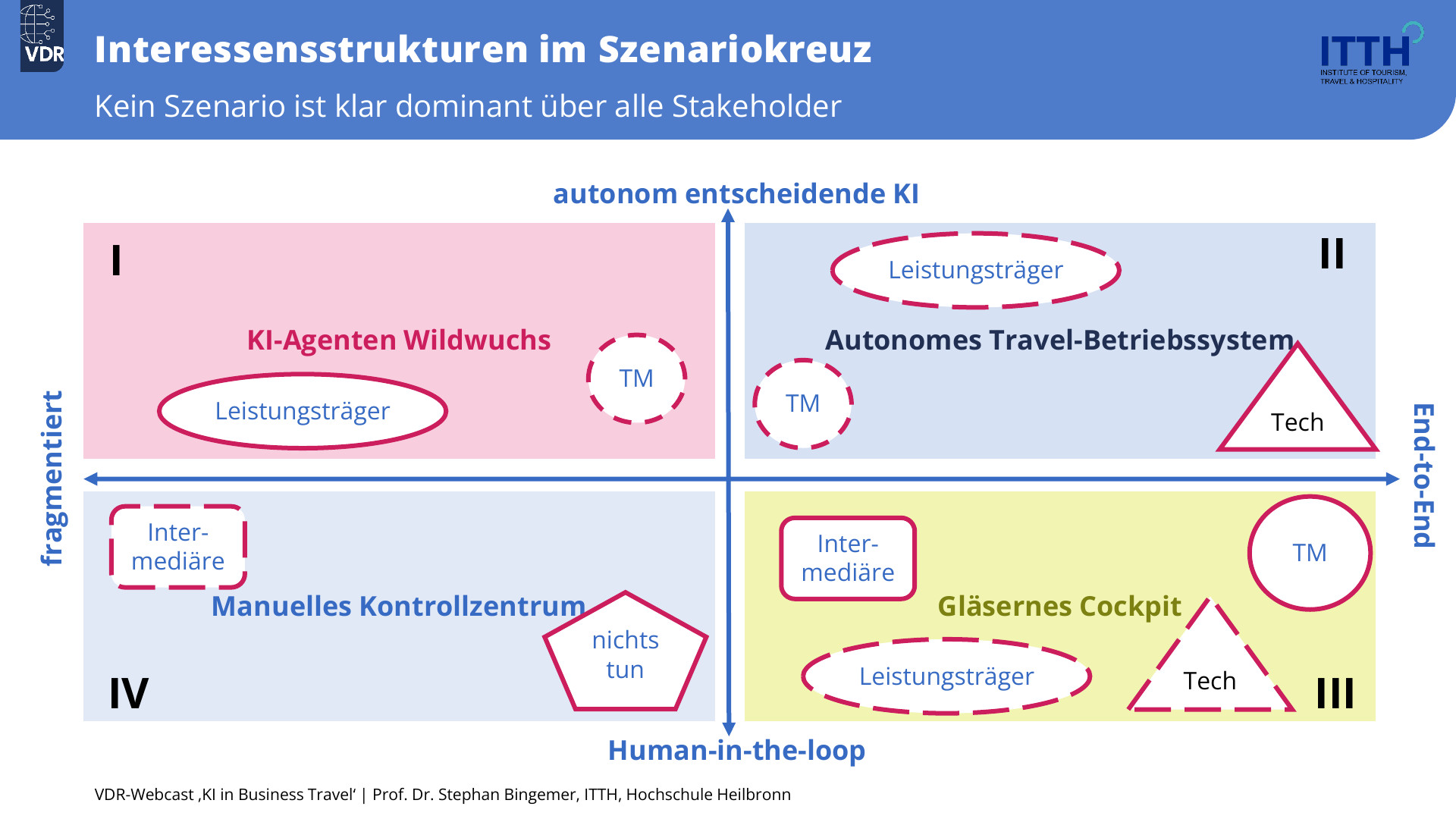
- Technology providers look towards autonomy, because autonomous systems are easy to sell. They often overlook the sprawl scenario, where no company system is used at all.
- Intermediaries such as TMCs find the glass cockpit attractive. Their nightmare is disintermediation by an autonomous operating system.
- Suppliers (airlines, hotels and so on) can live with the autonomous system and the cockpit, and they also benefit from the sprawl, because it becomes hard to control where travellers buy.
- Travel managers often named the glass cockpit as their target picture. They currently tolerate the sprawl partly for lack of better systems, but see it critically because of maverick buying. An autonomous system would completely redefine their job.
The core message: sovereignty lies in the decision logic
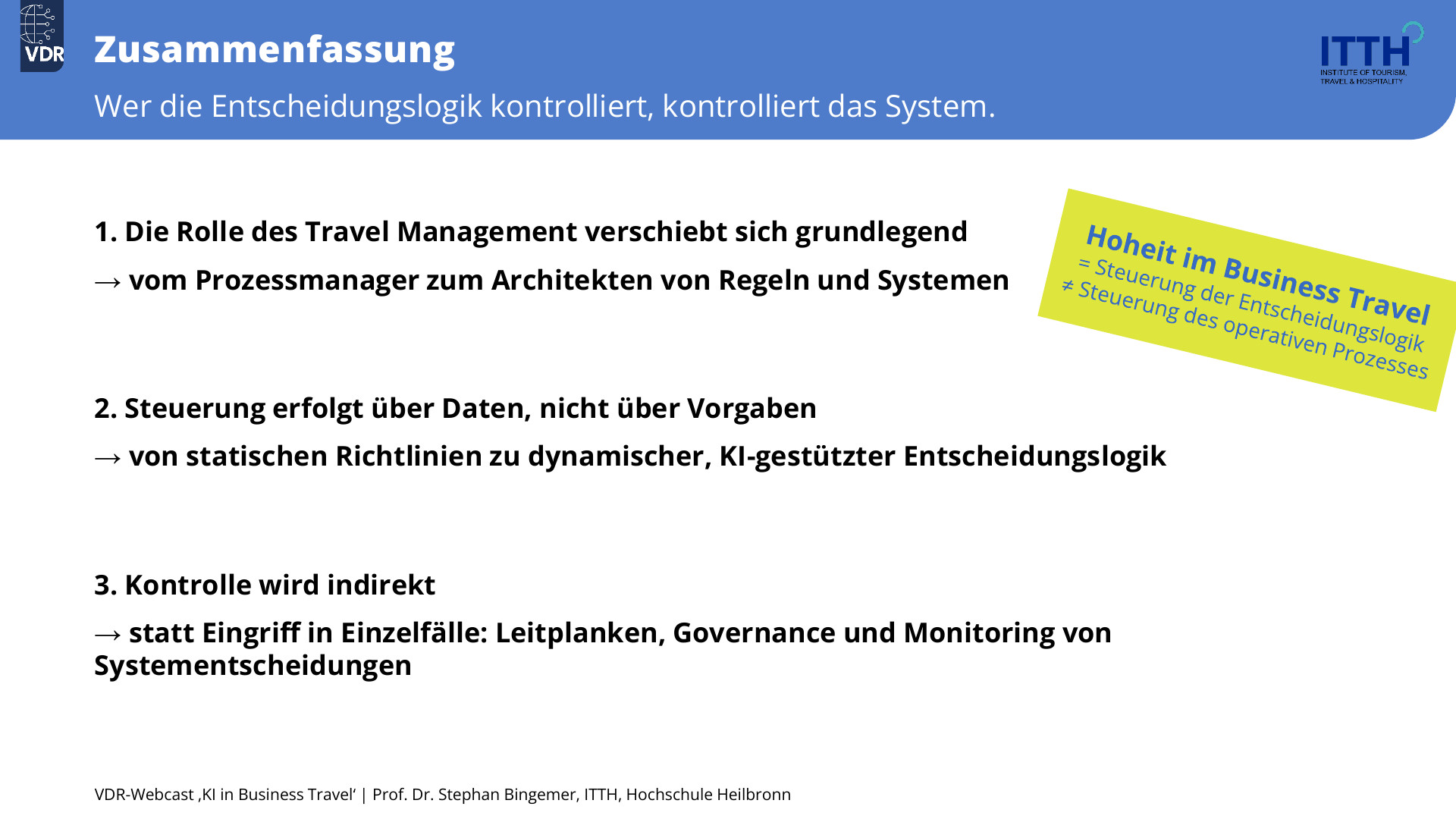
In business travel, sovereignty will no longer be decided in the operational process but in the decision logic. This means:
- The travel manager moves from process manager to architect of rules and systems, even if scenario 2 never materialises.
- Steering happens through data rather than through rules. Static policies need to become dynamic.
- Control becomes indirect: fewer interventions in individual cases, more governance and monitoring.
The strategic options differ by scenario. For the sprawl, you need minimal governance with data transparency and clear liability limits. For the autonomous system, you need meta-governance: by which criteria should the system decide? In the cockpit, it is data-based policies and clearly defined points where humans intervene. In the manual control centre, complexity must come down, decisions must speed up and processes must be standardised, otherwise you will be behind in ten years. The study recommends building skills in data management, AI governance, process design and compliance.
From the Q&A
- Which scenario will happen? Bingemer declined to answer, as any serious futurist does. As an example he cited a scenario for VisitScotland that considered the possibility of a pandemic long before Covid. Scenarios are readjusted continuously at turning points.
- AI regulation: He pointed to the European AI Act and to the fact that AI systems are regulated through filters before and after the model. His advice: use AI responsibly, and do not commit too early to one system that controls the entire company.
- Will AI replace the travel manager? No, but tasks will shift. Relief from operational work should be used for strategic work. A controlling function remains necessary.
- Private AI use: The first question is whether you actually want to prevent maverick buying. You need guidelines on which company data may go into private AI tools. Bingemer is no fan of “policing” because it damages trust. A better approach is an internal AI environment that offers enough added value to make the private device unnecessary. It is also important to involve other stakeholders, so that you do not end up with five different AI policies in one company.
- Where to start? With your data. AI systems are only as good as the data they work with, and a tool on poor data leads to disappointing results.
My take for Switzerland
- The data was collected in Germany. The scenarios apply to the DACH region, but the companies surveyed were from Germany. The study is qualitative and not representative. Whether Swiss companies weigh things differently, given their structures, data protection culture and supplier landscape, remains open.
- The sprawl is not the future, it is the present. This was the most important point of the presentation for me. If you want to know where you stand, you do not have to wait until 2035. You can check today which private AI tools your travellers already use.
- I expect hybrids. Depending on the company and the type of trip, several scenarios will exist side by side. This is my personal view, not a statement from the study.
- Every group of players has its own interests. The study makes this very clear. When you design the rules, it pays to get an outside perspective.
Three questions for your company
- Which private AI tools do our travellers already use, and with what data?
- How consistent are our travel, expense and policy data, and where are the silos?
- Who decides which decisions an AI may make or prepare, and which scenario is our target picture?
If you would like to work through these questions together, for example in a workshop on an AI roadmap for your travel management, please get in touch with TravelBrain Consulting.
Sources: VDR white paper “KI in Business Travel – Wie Künstliche Intelligenz das Corporate Travel Management bis 2035 verändern könnte” (October 2026), VDR press release of 9 October 2026 and the VDR webcast on the study of 9 October 2026. The white paper (in German) is available as a free download: https://www.vdr-service.de/whitepaper-ki-in-business-travel/download-vdr-whitepaper-ki-in-business-travel
Further reading: A short version (in German) appeared in Business Traveltip: Wer entscheidet 2035 über Ihre Geschäftsreisen?