
Research period: 9 – 16 November 2026 (Week 47) · Published 16 November 2026 · Source scope: Global

Every week, the TravelBrain team reviews dozens of newsletters and websites to capture the latest developments and trends in travel management and travel technology. This research and the summarization of the key points is carried out with AI support. If you would like to discuss any of these topics with us, or need support on one of them, please let us know.
Executive Summary
Fragility was the theme of the week. A communications failure at US air traffic control halted the entire US airspace for more than four hours on 13 November, while Middle East suspensions keep getting longer: SWISS will not fly Zurich–Dubai until late March 2027. AI agents exposed a split: United is blocking unauthorised agents, just as Travelport, Booked AI and Mastercard completed the first live NDC flight purchase handled end to end by an agent. On costs, Air France-KLM lifts its EDIFACT surcharge from €4 to €7 in 2027, and GBTA expects European spend to rise 7 % on barely more trips. Among TMCs, CTM reported lower revenue and Altour named a new president.
1. Travel Management General
GBTA/VDR Europe Conference: European spend rises, trip volumes barely move
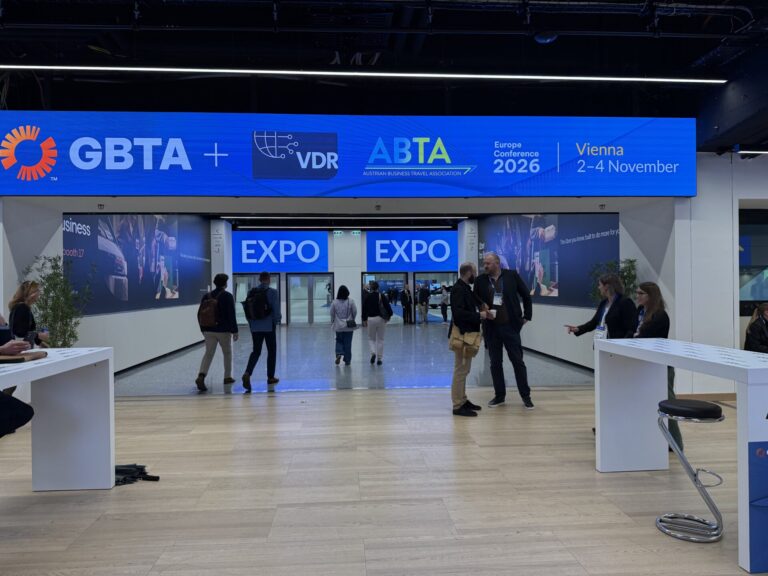
At the GBTA + VDR Europe Conference in Vienna (2–4 November, close to 1,400 attendees from 41 countries), the GBTA Business Travel Index forecast European corporate travel spend of €404 billion for 2026, up 7 %. Trip numbers are expected to grow just 0.7 % to around 600 million. VDR’s sentiment barometer finds 55 % of German companies managing travel more selectively than a year ago, with cost gaining weight for almost 61 %. Average sustainability maturity across programmes sits at 1.5 out of 5.
BT4Europe welcomes EU sustainable tourism strategy but wants business travel to count for more
European business travel network BT4Europe has welcomed the European Commission’s new sustainable tourism strategy, which includes faster visa procedures, less red tape, more digitalisation and data sharing, and better links between transport modes, plus a planned EU tourism alliance. Its criticism: business travel appears mainly in an accompanying working paper, and BT4Europe wants it treated as a distinct focus area of EU tourism policy.
Takeaway: More expensive, not more frequent: the European figures confirm companies are travelling more selectively while cost per trip rises. In Brussels, business travel is only slowly gaining a voice.
2. Online Booking
Perk builds Airbnb into its booking tool via API
Perk has connected Airbnb through a new API integration: travellers see listings with live pricing and availability in the Stays tab, submit booking requests and manage accepted stays inside Perk. Bookings follow the same policy controls and spend visibility as flights, hotels and rail. Previously, Airbnb stays were handled manually by Perk’s concierge; Airbnb nights booked through Perk rose 94 % over two years, and the average stay is nine nights.
Spotnana automates the full lifecycle of unused ticket credits
Spotnana now covers unused airline credits end to end: companies can move eligible credits from one traveller into a company pool that colleagues can redeem through self-service booking. Name changes are automated for NDC and EDIFACT credits; for most airlines this creates an Agent Desktop task, while United NDC credits are handled fully automatically. Rule-based automatic transfers are planned. Spotnana says 96 % of credits are redeemed before expiry (vendor figure).
Takeaway: Booking tools are closing programme gaps: alternative accommodation and unused tickets, both classic sources of leakage and waste.
3. TMCs
CTM: revenue down 8.5 percent as UK repayments continue
Corporate Travel Management reported an 8.5 % year-on-year revenue decline for its fiscal first quarter (July–September), while transactions rose 3.3 %. It has repaid about a third of the amounts owed to UK clients who were overcharged by up to roughly $157 million. Client retention exceeded 97 % in the fiscal year to 6 November, new business wins reached about $177 million, and the shares resumed trading in September.
Altour: Gabe Rizzi steps down, Brian Mogler named president
After about ten years, Gabe Rizzi is stepping down as president of Altour and becomes a senior advisor at parent Internova Travel Group. His successor is Brian Mogler, most recently executive vice president and chief partnership officer at CWT, with twelve years each at American Express and United Airlines. He will oversee operations and business performance.
Takeaway: People and financials dominated the TMC week; the sector’s broader reshaping (new ownership at Amex GBT, consolidation at Internova) continues.
4. Expense Management
Findity and Suiteify launch Expense & Travel for German mid-sized firms
Swedish embedded-expense provider Findity and Suiteify (formerly Infoniqa) have launched “Suiteify Expense & Travel” in Germany. The AI-powered product covers real-time card transactions, receipt capture, mileage and per diems, and supports German tax and GoBD compliance. Suiteify supplies HR, payroll, finance and ERP software to mid-sized companies in the DACH region and cites more than 40,000 customers.
Background: Skift report shows strong appetite for unified T&E
Skift’s “State of Corporate Travel and Expense 2027” finds 45 % of managers describe their expense process as highly or fully automated, yet just as many still review, approve and reconcile manually. The share of travellers spending at least an hour on an expense report rose from 35 to 45 % in a year. 79 % of managers want a unified T&E solution, but only 21 % say their current platform meets their needs; cost (47 %) and training (41 %) hold back switching.
Takeaway: A quiet week for expense: the only new item targets DACH mid-sized companies, while the Skift report explains why unified solutions are in demand.
5. Travel Risk Management
US air traffic control halts all departures for over four hours
The FAA issued a nationwide ground stop at 3:54pm Eastern on Friday after a communications problem hit all 22 air route traffic control centres, lifting it at around 8:15pm. FlightAware counted at least 4,000 cancellations and more than 10,000 delays, affecting about 1.5 million passengers. Officials see no sign of a cyberattack; the cause, including a router or software update, is under investigation. Disruption carried into the weekend.
Gulf: SWISS suspends Dubai until late March, Saudi Arabia remains high risk
Lufthansa Group is cutting most Dubai flights until the end of the winter schedule on 27 March 2027: SWISS suspends Zurich–Dubai (a restart had been planned for 25 November), as do Austrian, ITA and Lufthansa from Frankfurt. Only Munich–Dubai and Eurowings Berlin–Dubai are still due back on 25 November. For Saudi Arabia, Australia’s Smartraveller has advised against all travel since 11 November; per Travel Monitor, suspensions include Etihad (to 19 November), KLM (to 27 November), Air France Riyadh (to 12 December) and Cathay Pacific Riyadh (to 31 January 2027).
Europe: Dublin summit, Spanish general strike, storm in Portugal
In Dublin, an EU leaders’ summit on 12–13 November brought road closures and what the US Embassy called the largest security operation in the state’s history, plus a possible national strike on 12 November; United offered fee-free rebooking for affected flights. The UK updated its Spain travel advice for a 24-hour general strike on 11 November. Storm Charles caused almost 400 cancellations in Portugal on 11 November, and Naples airport is closed for runway works until 30 November.
Takeaway: Infrastructure, geopolitics and weather: the week covered the full range. What matters is less the forecast than how fast programme and TMC respond.
6. NDC
Air France-KLM raises its reduced EDIFACT surcharge to €7
From 1 January 2027, Air France-KLM will raise its reduced surcharge on bookings through legacy GDS channels (EDIFACT) from €4 to €7 per direction. It applies to travel management companies in France and selected international agencies until 30 June 2027; the standard surcharge is €24 per direction. The €4 rate had earlier been extended to the end of 2026, citing jet fuel prices and market uncertainty.
First live purchase of an NDC flight by an AI agent
Travelport, Booked AI, Basis Theory and Mastercard report a flight purchase handled entirely by an AI agent: Booked AI’s agent searched, booked, paid for and ticketed a live NDC offer from an unnamed major airline via Travelport TripServices. Payment used a tokenised credential (Mastercard Agent Pay with Basis Theory’s vault), and Mastercard Verifiable Intent tied the payment to the customer’s approval. The airline remained the merchant throughout.
Takeaway: NDC is moving on two fronts: airlines are raising the price of the legacy channel, and the new interface is becoming the basis for AI-driven booking.
7. AI in Travel
United blocks unauthorised AI agents
United Airlines is restricting “unauthorised, third-party personal AI agents” that book flights or manage reservations for customers, both on its own platforms and indirectly through agencies and aggregators. It cites risks from shared credentials, unintended purchases or use of miles, and rules requiring a human to complete steps such as check-in acknowledgements. Delta allows agents that log in with customer credentials; American is still evaluating.
Engine survey: AI improves control, not necessarily cost
Engine surveyed 1,000 US business travellers and decision-makers: 76 % would let AI decide whether a business trip is worth taking, but only 16 % would let it act without checking during major disruptions. Among those who have measured the impact, 60 % report higher costs and more time spent, while 77 % see better visibility and 71 % better policy compliance. This is a vendor survey.
BizTrip AI brings booking into Slack, Teams and iMessage
US start-up BizTrip AI has launched a beta of its planning and booking agent in Slack, Microsoft Teams and iMessage. Travellers search, compare and book in the chat, with company policy applied before options are shown; rebooking after a cancellation can also happen in the thread. In September the company launched integrations with ChatGPT and Claude; Sabre has held a stake since early 2026.
Takeaway: The question is no longer whether AI agents will book, but through which channels and with what approval. Airlines, payment providers and tools are drawing the guardrails now.
Trend Analysis & Outlook
Cross-cutting trend 1 – Resilience over prediction: A US ground stop, Gulf suspensions and several European disruptions in a single week show how hard events are to foresee. What counts is locating travellers fast, rebooking proactively and having clear alternatives in policy.
Cross-cutting trend 2 – Agents need authorised channels: While United shuts out unauthorised agents, the Travelport–Mastercard purchase shows what a controlled path looks like: NDC offer, tokenised payment and documented approval. Companies should set their rules for AI-assisted booking now.
Cross-cutting trend 3 – Costs rise through price: Higher spend on flat trip volumes, a higher EDIFACT surcharge, and tools that cut leakage (Airbnb) and waste (unused tickets): 2027 will be a year of cost discipline through process rather than travel bans.
Outlook: Watch the investigation into the FAA outage and the recovery of US operations, the situation in Saudi Arabia and the Gulf, and whether other airlines follow United or govern agent access via NDC. For the 2027 budget round, review your EDIFACT share with Air France-KLM.