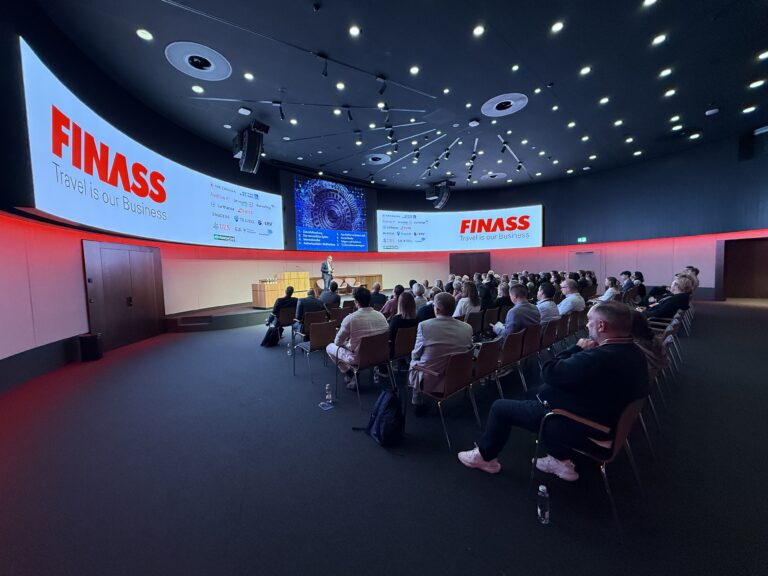
After about 2 1/2 years of a break due to the Corona pandemic, Daniel Wittwer and his business travel team from Finass once again invited participants to the Business Travel Workshop. Under the title “Traveller Journey – how new technologies are sustainably changing business travel,” a varied and informative program was offered. At the invitation of Daniel Wittwer and Marc Brunner, I was delighted to be part of the event again this year.

The relief of finally being able to welcome customers and partners to an in-person event was palpable in Daniel Wittwer’s speech. Not everyone is ready for such events yet, but many current and potential customers still found their way to the SIX Convention Point in Zurich. Before diving into the afternoon topics, Wittwer introduced the present Finass employees and the company’s new CEO, Claudine Furrer. After a brief introduction to the upcoming presentations and the day’s program, Wittwer handed the microphone over to Christian Rosenbaum from i:FAO, the head of the technology committee at the German VDR.
E-wallets and biometrics – travel is becoming more digital, whether we like it or not. Touchless travel and biometrics simplify business travel.
As a regular guest at the Finass Business Travel Workshop, the German colleague Rosenbaum knows how to captivate and inspire the audience. Whether with his newly learned word “Pfnüsel” for his light cold or his role as an amateur archaeologist in his hometown, he always has a fitting remark ready. Through numerous examples, he showcased in his presentation where facial recognition or fingerprint recognition processes are already being used today. Everyone knows this from their smartphones, laptops, or entering certain countries. Airlines, airports, car rental companies, and government agencies are also working hard to make our digital identities available via e-wallets and the cloud for various processes along the traveller journey. For example, relevant data is automatically displayed as the traveler approaches the check-in, the baggage drop-off, or during the entirely contactless pickup of a rental car. For instance, passport data and driver’s license data are automatically transmitted as soon as the car rental company’s camera identifies the customer via facial recognition. Of course, the release of the data must first be enabled by the user, and the data would be deleted immediately after the transaction. Following his presentations, there were several questions about data security, privacy, and how less tech-savvy travelers would manage. Christian Rosenbaum noted that there would definitely still be coexistence between old and new processes in the coming years – but travel is becoming more digital, whether we like it or not!

Amadeus cytric Travel & Expense and collaboration with Microsoft.
As if there weren’t enough news yet, Christian Rosenbaum also dropped another bombshell. Amadeus has formed a close partnership with Microsoft, resulting in the complete integration of Amadeus cytric Travel & Expense into the Microsoft Teams environment. This new version is marketed under the name cytric easy. An additional integration into Outlook is in the works and should also be available soon.
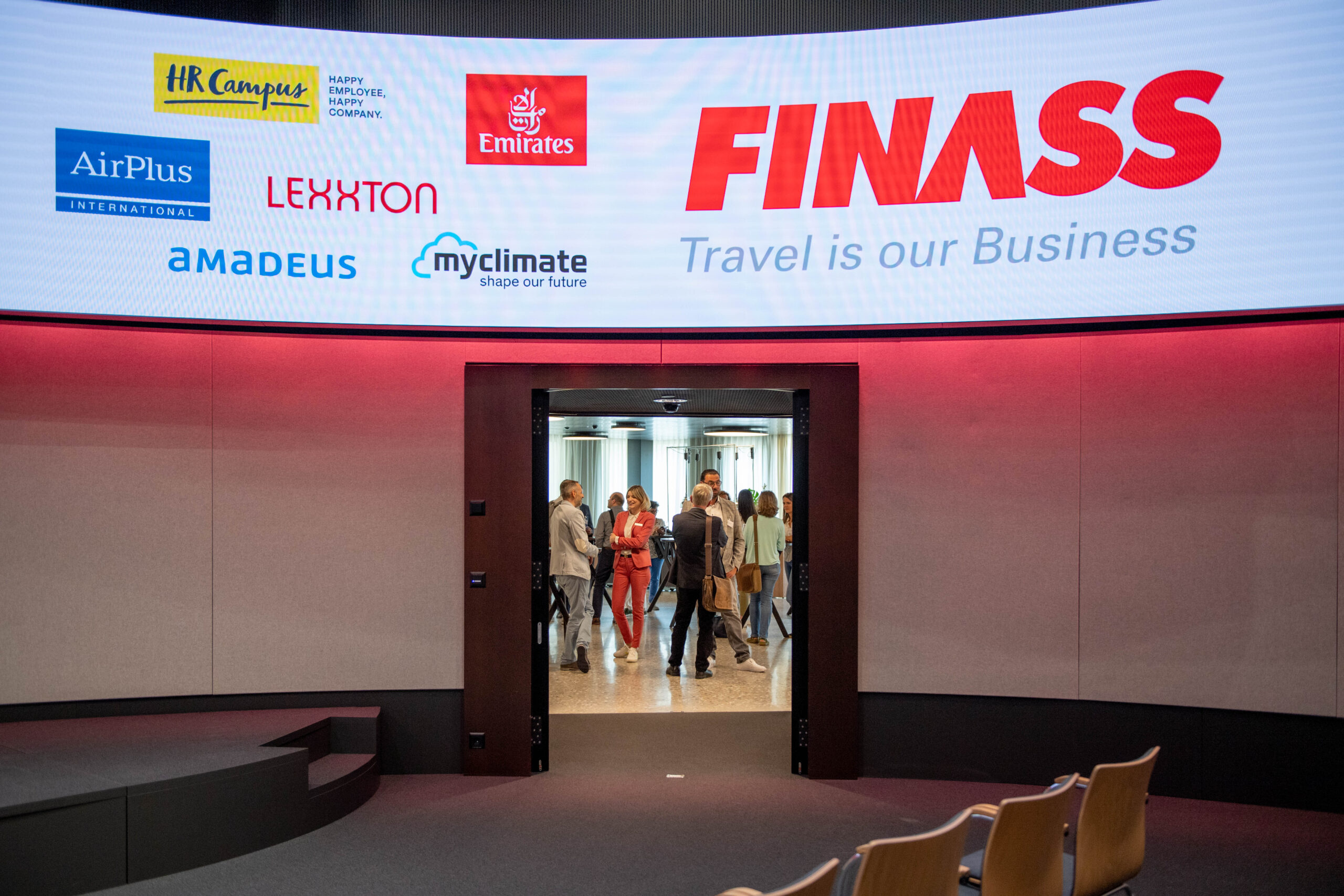
During the subsequent networking break, visitors had the opportunity to learn about the offerings and services of the exhibitors and partners of the Finass Business Travel Workshop. And of course, there was extensive discussion about what had been seen and heard so far. It was wonderful to once again converse face-to-face with those responsible for travel and suppliers.
Mobility risk management, travel security – necessary evil or sensible precaution.
The second part of the event was opened by Marc Brunner, Daniel Wittwer’s deputy, who then handed the stage to Urban Lederer, CEO of Lexxton AG in Brüttisellen.

For many companies, travel/mobility risk management is still a necessary evil. Not everyone sees the benefits of comprehensive care for their employees during the planning, execution, and follow-up of a trip. Urban Lederer, CEO of Lexxton, pointed out that simply acquiring a tool for monitoring or tracking travelers is not enough. Lexxton offers X-Assist, which covers key points such as providing country information before the trip, immediate notification in crisis situations, and the ability to communicate with affected individuals (travelers, expats, or employees at a location). However, without a comprehensive strategy for duty of care and preparing for emergency scenarios with corresponding processes in the company, the structure is likely to collapse very quickly in critical situations. The new ISO Standard 31030, adopted in autumn 2021, elevates the topic further and allows companies to approach professional travel risk management with standardized guidance. More information is available on the ISO organization website or our TravelBrain webpage dedicated to the topic. Urban Lederer encouraged attendees to familiarize themselves more deeply with the subject, especially since the legally regulated duty of care obliges companies to protect their employees. When necessary, it is definitely worthwhile to bring in external support to set up a professional travel/mobility risk management program.
It has become a tradition – and expectations are high! But Daniel Wittwer and his team always manage to take it a step further. A captivating presentation, outside of all business travel topics, traditionally concludes the official part of the Finass Business Travel Workshops. This year, he managed to engage Anja Blacha, a German extreme athlete living in Zurich, as a speaker. At first glance on stage, the rather small and graceful person might have seemed capable of many things, but certainly not climbing 8000-meter peaks or leading an expedition to the South Pole. However, Anja Blacha took the astonished but captivated audience on these journeys. Coming to mountaineering relatively late, she decided on it after a hike in Iceland and bought her first mountaineering boots at the age of 22. She shared, with many pictures as illustration, how she, after initial failed attempts, climbed first Broad Peak (8051 m) and then K2 (8611 m), the second-highest mountain in the world, without bottled oxygen as part of a small group. She spoke of fear, setbacks, but also the immense joy of reaching the summit and safely descending it despite the dangers. But there were many other boundaries to explore. For example, she crossed Antarctica solo, pulling a sled weighing over 100 kilograms over a distance of 1400 kilometers to the South Pole in just 58 days – a historic record. She shared her long preparation, the detailed Excel calculations of weights and calories, and of course, the expedition itself. Days on cross-country skis under radiant sunshine or in fierce storms, without seeing her own skis or the sled behind her, just following the compass needle in front of her face. Until, finally, the South Pole was reached – the first woman to do so solo! The amazement on the participants’ faces seemed endless. After well-deserved applause, Anja Blacha gladly answered some questions and took the time during the concluding aperitif to continue exchanging ideas.


At the concluding networking aperitif, there was another opportunity to interact with exhibitors and partners. But naturally, at first, discussions mainly revolved around the fascinating achievements of Anja Blacha. Almost everyone in the room briefly reflected on where their own boundaries might lie. The Finass team really pulled out all the stops after the forced break, organizing a great program with top-notch speakers. Well done again, dear Dani and dear Marc! Congratulations. For more information about this year’s and past workshops, as well as, if available, presentations for download, please visit the Finass page dedicated to the Business Travel Workshop. And for those who want to save the date, the next workshop will take place on September 14, 2023. Adrian Matt for TravelBrain.